Watching a Cryptocurrency market that never sleeps gets old fast, which is why ai crypto trading bots stay in demand. The right bot can monitor price action, react to a market trend, and execute a trade through an API while you focus on your wider investment plan. The best option in 2026 depends on your trading strategy, your technical comfort level, and the Cryptocurrency exchange you actually use.
Which Platform Stands Out in 2026
No single bot wins for every trader. Some tools lean hard into customization and algorithmic trading, while others aim for easier automation with templates or copy features. After comparing the field, these are the crypto trading bot platforms worth a closer look in 2026.
| Platform | Supported Exchanges | Pricing |
|---|---|---|
| 3Commas | Binance and Coinbase, plus other major platforms | Free 14-day trial. Paid plans from $15 to $160 per month |
| Cryptohopper | Binance and Kraken, plus other well-known exchanges | Free plan available. Paid tiers from $24 to $107.50 per month |
| Altrady | Binance and Bybit, plus more supported venues | Free backtesting plan. Paid plans from $23 to $73 per month |
| Hummingbot | More than 35 venues, including Coinbase and Kraken | Free to use, with normal network and trading fees |
| Gunbot | More than 20, including Binance and Bybit | One-time license from $59 to $249 |
| HaasOnline | Binance and Bitfinex, plus other major exchanges | Custom pricing on request |
| Mizar | Binance and OKX, plus several others | Free to $30 per month, with extra volume fees by tier |
| Cryptohero | Binance and Coinbase, plus additional exchanges | 14-day money-back guarantee. Paid plans from $19.99 to $39.99 per month |
3Commas
3Commas is a serious platform for active market participants who want deep control over short-term execution. It works best for people comfortable adjusting an algorithm as conditions change, especially if they use signal-based entries and want broad exchange coverage.
From what I found, the interface is powerful but dense. That is the trade-off. You get strong automation, flexible strategy tuning, and the ability to work across more than one venue from a single dashboard. Futures support is broad, and some margin functionality is available too.
This is not a set-and-forget tool. If your approach depends on fast shifts in data or sentiment, you should expect regular maintenance.
Exchanges supported - Binance and Coinbase, plus a wide selection of other major platforms.
Pricing - A free 14-day trial is available. Paid plans start at $15 per month and go as high as $160.
Cryptohopper
Cryptohopper is one of the clearest fits for anyone searching for an AI trading bot that serves both new users and experienced traders. It blends automation with Artificial intelligence features, and it gives users one place to manage connected accounts while funds stay on the exchange.
Beginners can lean on copy trading or automated setups fed by market information. A simple starting path is to connect an exchange by API, choose a template or signal source, and test it with paper trading before going live. Tools such as trailing orders and dollar-cost averaging help with risk handling without forcing constant screen time. That makes it easier to build an automated trading system without coding.
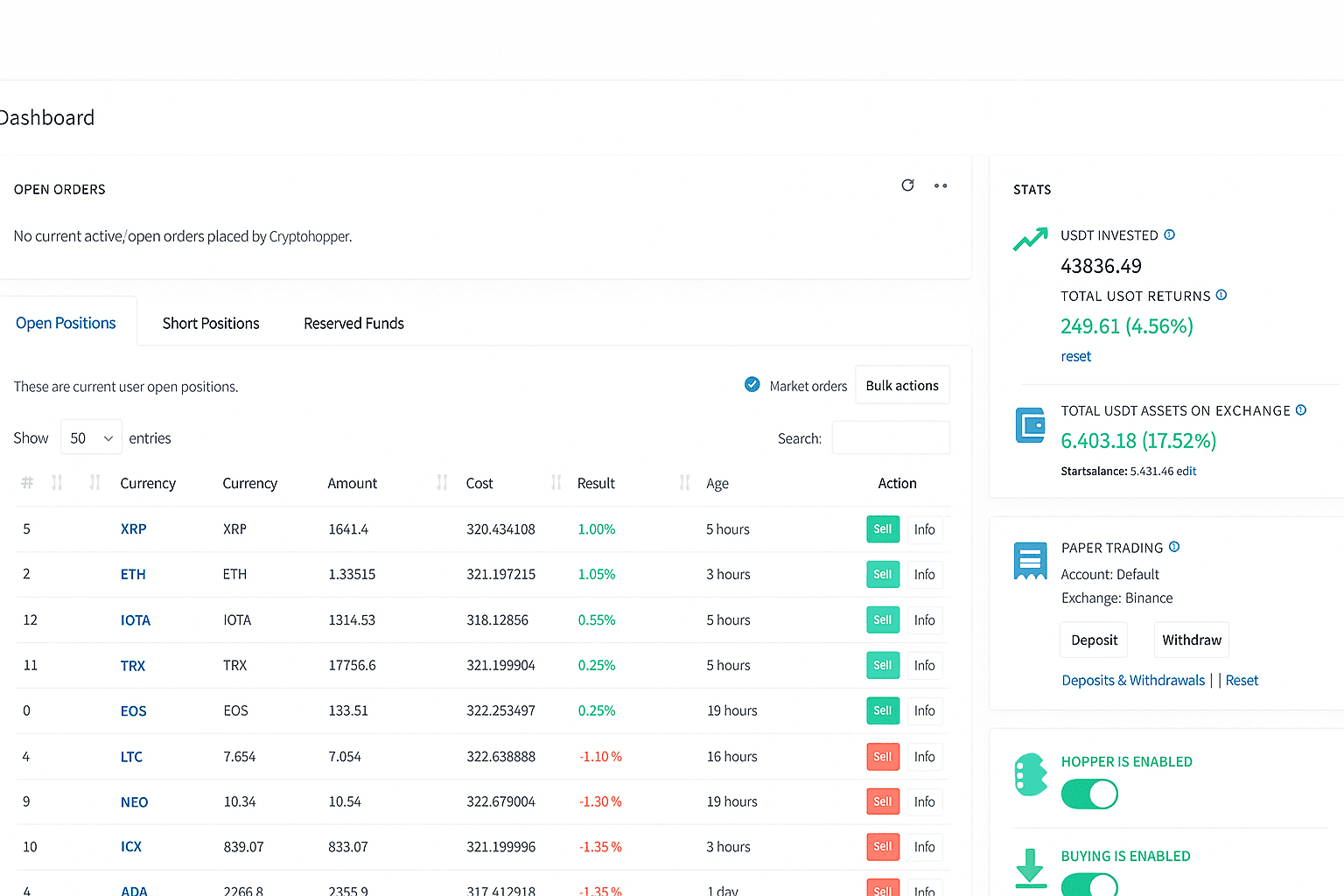
Advanced users get more room to work. Cryptohopper includes an AI layer that adapts around your trading logic by reading pattern changes in market data and indicator behavior. In practice, that means the software can adjust how it applies your strategy rules instead of running the same static setup every time. It also includes a strategy designer, Backtesting, and an Arbitrage tool for exchange price gaps.
Exchanges supported - Binance and Kraken, along with many other well-known exchanges.
Pricing - There is a free plan with unlimited copy bots. Paid tiers begin at $24 per month and reach $107.50.
Pionex
Pionex combines an exchange with built-in bot software, and that setup keeps things simple. The platform lists more than 346 coins and processes heavy daily volume, but the main draw is the pack of 16 built-in bots that users can access at no extra cost. It is also widely known as a no KYC platform.
This is one of the easiest free entries into automation. New users get trial funds to test ideas without taking immediate risk, and PionexGPT can help with strategy research or setup ideas. If you are still learning how ai trading works, that extra guidance is useful.
Bots available - You get common setups for grid trading and DCA, along with other long-term and short-term tools inside the exchange.
Pricing - The bots are free on Pionex for spot and futures markets.
Altrady
Altrady mixes bot automation with portfolio management, and the result feels practical. You can manage trades on several exchanges from one screen, while also seeing live market data and news in the same workspace.
The platform includes signal bots and grid bots, along with DCA tools and order controls such as trailing stops. I also like that it includes a journal, which helps a trader review decisions and improve an algorithm over time instead of trading on emotion.
It suits newer users because the layout is approachable, but there is enough technical depth for experienced chart users as well.
Exchanges supported - Binance and Bybit, plus a broader set of supported venues.
Pricing - There is a free backtesting plan. Paid plans run from $23 to $73 per month.
Hummingbot
Hummingbot is open-source software aimed at professional users, especially firms handling liquidity or advanced market making. Casual users will likely find it heavy, but the flexibility is real if you know your way around code.
Its strength is in institutional-style execution. You can build for Arbitrage or liquidity operations across both CEX and DEX environments, and you can rewrite the codebase to match a very specific use case. That gives you more transparency than many subscription tools.
It takes work to deploy and monitor well. For advanced users, that effort can be worth it.
Exchanges supported - It connects to more than 35 venues, including Coinbase and Kraken.
Pricing - Free to download and use, with normal network and trading fees still applying.
Gunbot
Gunbot is built for users who want local control. It runs on your own machine, which means API keys and account data stay with you instead of sitting on a third-party server.
That self-hosted model appeals to privacy-focused traders. It also supports a wide mix of strategies, and advanced users can create custom logic through JavaScript or TradingView alerts. Spot and futures automation are both on the table, and you can run as many pairs as your setup can handle.
Telegram support is handy for monitoring. You can check performance and send commands without logging into the main dashboard every time.
Exchanges supported - More than 20, including Binance and Bybit.
Pricing - It uses a one-time license instead of a subscription. Plans start at $59 and go up to $249.
HaasOnline
HaasOnline stands out because its desktop version keeps the full bot environment local. A cloud option exists too, though the local install is still the main point of difference.
Running software on your own machine helps keep API credentials private, but there is a catch. Your system has to stay online, and you handle updates yourself. Cloud bots are easier in that respect because they keep running even when your laptop is closed.
Still, HaasOnline offers deep tools for technical users, including algorithm design and a visual editor. It makes the most sense for people with some development background or at least solid platform experience.
Exchanges supported - Binance and Bitfinex, plus a range of other major exchanges.
Pricing - Custom pricing only. You need to contact HaasOnline for a quote.
Mizar
Mizar is a flexible platform with support for spot and futures trading across more than 10 exchanges, and it does that without a traditional subscription model. That pricing structure will appeal to users who dislike fixed monthly costs.
Its marketplace is one of the more interesting parts. You can follow top-performing traders, which can help with diversification and idea generation, especially if you are still refining your own trading strategy. The Smart Trading Terminal also works with TradingView, so chart-based execution feels direct.
Power users can run DCA bots, connect through an SDK, and paper trade before going live. Mizar also has a DeFi product, which broadens its reach beyond standard exchange automation.
Exchanges supported - Binance and OKX, along with several others.
Pricing - Plans range from free to $30 per month, with extra volume fees based on account tier and STAR holdings.
Cryptohero
Cryptohero is aimed squarely at beginners who want an AI-assisted tool without a steep setup process. It feels accessible, and that matters if your main goal is getting an automated trading system running quickly.
You can build and test bots without coding. Paper trading and Backtesting are included, and the platform supports long or short logic plus range-based systems. It also works with common indicators like RSI and EMA, which helps new users bridge the gap between chart study and automation.
This one is a sensible low-cost option for people short on time or working with a smaller portfolio.
Exchanges supported - Binance and Coinbase, plus a long list of additional exchanges.
Pricing - A 14-day money-back guarantee is offered. Paid plans run from $19.99 to $39.99 per month.
How These Bots Work
Crypto trading bots are software programs that automate actions across one or more exchanges. In simple terms, you define the rules, connect the bot through an API, and let the algorithm watch data from the market. Once your conditions are met, the bot can place or close a trade on your behalf.
That logic can be basic or adaptive. A standard bot may follow fixed rules based on indicators or price levels. AI-driven bots go further by using machine learning or pattern recognition to process more information and adjust to changing conditions over time. The data source is not limited to chart signals either. Some ai crypto trading bots also react to news flow or social sentiment alongside technical inputs.
In practice, the better platforms pull in structured market data and unstructured information, then use that stream to trigger entries, exits, or portfolio changes. Some also support reporting, paper trading, and strategy feedback loops so the system can improve after live testing.
Why Use a Crypto Trading Bot
AI crypto trading bots are execution tools, not proof of profit. Strategy quality and risk control still decide most of the outcome.
AI crypto trading bots are execution tools, not proof of profit. Strategy quality and risk control still decide most of the outcome.
Crypto trades around the clock, and that creates opportunity along with pressure. A human trader gets tired, gets distracted, and sometimes lets emotion interfere with execution. Bots do not have that problem. They can watch Bitcoin and other assets continuously, then respond faster than a manual workflow usually allows.
That does not mean they print income on demand. They follow instructions, or in the AI case, trained decision models. If the strategy is weak, the result will still be weak. Market volatility can break a good setup fast, and technical failures like API disconnects can interrupt execution at the worst time. AI models can also overfit Backtesting data, which makes historical results look stronger than live trading. Past performance does not guarantee future results.
So, do AI crypto trading bots actually work and are they profitable? Technically, yes, they work. Reputable platforms can execute orders, scan markets, and manage rules effectively. Profitability is a different question. This page does not provide verified live returns for the platforms above, and most of the proof on offer is limited to Backtesting or paper trading tools rather than audited performance data.
How to Pick the Right Bot
Your best pick starts with fit. Some traders want full control over code and hosting. Others want a simpler interface that can connect Binance or Kraken in minutes. Before paying for anything, check whether the bot supports your exchange, your preferred asset types, and the kind of trade logic you plan to run.
Testing matters too. Good platforms offer Backtesting on historical data and sometimes paper trading in live conditions. That will not prove future ROI, though it does help you catch broken logic and unrealistic assumptions before real capital is involved.
- Automated trading - The bot should let you build or import a strategy, then execute it without manual clicks.
Automated trading - The bot should let you build or import a strategy, then execute it without manual clicks.
- Backtesting - Historical testing helps verify whether an algorithm has any edge before you deploy it.
Backtesting - Historical testing helps verify whether an algorithm has any edge before you deploy it.
- Technical indicators - Look for support for tools such as MACD and RSI if your system relies on chart signals.
Technical indicators - Look for support for tools such as MACD and RSI if your system relies on chart signals.
- Risk management - Stop-loss logic and position controls are essential if you want the software to handle exposure sensibly.
Risk management - Stop-loss logic and position controls are essential if you want the software to handle exposure sensibly.
- Exchange support - Always confirm that your preferred Cryptocurrency exchange is supported through a stable API connection.
Exchange support - Always confirm that your preferred Cryptocurrency exchange is supported through a stable API connection.
- Security - Features like encryption and 2FA matter because account access is a real attack surface.
Security - Features like encryption and 2FA matter because account access is a real attack surface.
- Ease of use - A clean interface can save a lot of time during setup and daily checks.
Ease of use - A clean interface can save a lot of time during setup and daily checks.
- Cost - Prices range from free access to premium plans that cost far more over a year.
Cost - Prices range from free access to premium plans that cost far more over a year.
Do Not Forget Taxes
Bot activity can create a huge trade count very quickly, which makes tax reporting harder than many users expect. If your accounts span the United States or another tax jurisdiction, you still need accurate records for gains and income.
A crypto tax calculator can simplify that job by importing transactions from wallets and exchanges, then organizing the information into usable reports. That matters even more when automation is placing orders around the clock and your portfolio history gets dense fast.
Building Your Own Crypto AI Bot
Creating your own bot takes more work than using a hosted platform, but it gives you full control over the logic. At a basic level, you need programming skill, exchange API access, and a way to test your rules before live deployment. Python is a common choice, and TradingView alerts or exchange webhooks can also be part of the setup depending on how you want signals to reach the bot.
The usual process is straightforward. You define a trading strategy, connect market data, and write execution rules. After that, you run Backtesting, then paper trade to see how the bot behaves with live price movement before risking capital. If you want an AI layer, that usually means training a model on historical data and checking whether it holds up outside the sample.
Some platforms in this list already support custom bot creation at different levels. Hummingbot is the most code-friendly option, while Gunbot and HaasOnline also give advanced users room to build custom logic.
FAQ
Does Binance Have a Trading Bot
Yes. Binance offers its own automated tools, including grid-style products and Auto-Invest options. If those built-in tools do not match your strategy, you can also connect an outside bot through API access.
Is There a Poloniex Trading Bot
Yes. Poloniex offers an AI spot grid bot that can be configured around your portfolio and preferred rules. You can also set it up manually if you want tighter control.
Do Crypto Trading Bots Actually Work
They do from a technical standpoint. A reputable bot can follow conditions, read exchange data, and place orders correctly. The harder question is performance. A bot only executes the logic it is given, so a poor strategy will still produce poor results.
Are Crypto Bots Profitable
They can be, but there is no fixed answer. Results depend on the strategy, the market, and account size. Backtesting helps, yet live trading can behave very differently once slippage, fees, or sudden volatility appear.
Are Crypto Trading Bots Free
Some are. Pionex includes free built-in bots, and several other platforms offer free plans or trial tiers. Paid upgrades usually unlock more automation or wider exchange support.
How Much Does a Trading Bot Cost
Costs range from zero to high annual spending. Entry plans may be inexpensive, while advanced software for serious users can cost far more, especially if it includes premium features or custom infrastructure.
How Much Can a Crypto Bot Make You
There is no universal figure. Returns depend on portfolio size and execution quality, and a large account with an average strategy may still produce more than a small account with a stronger setup.
How Successful Are Crypto Trading Bots
Success rates differ widely between products and strategies. A lower-risk setup may show strong consistency, while a more aggressive system may win less often but target larger moves. The useful question is whether the bot can execute your approach reliably.
What Happened to Shrimpy Trading Bot
Shrimpy said the platform would shut down in 2023, with final transactions completed on July 7, 2023. Users who relied on it need to move to another service.