A crypto futures trade lets you try to capture market moves without buying the coin itself, and that is the core of how to make money trading crypto futures. You deal in a futures contract tied to BTC, ETH, or another cryptocurrency, choose a direction, and manage your margin so a small price change can turn into either a profit or a fast loss.
Quick Answer
Crypto futures trading means working with contracts that mirror the price of assets such as Bitcoin or Ethereum instead of holding the assets in a cryptocurrency wallet. A trader can aim to earn money from a rise by going long or from a drop by going short. Leverage increases exposure, so results move faster, which is why a trading strategy matters before any position goes live.
Crypto Futures Basics
With crypto futures, you trade a contract rather than the underlying asset. You are making a call on where the market price may go next while using a derivative tied to that move.
That separates futures from spot trading. In spot, you buy and own the coin. In futures, you trade a financial instrument linked to the coin’s market value.
Most crypto perpetual futures are cash settled, so no coin gets delivered when the trade closes. Profit or loss is credited against your margin balance, and funding payments pass value between longs and shorts to keep the contract price close to spot.
That structure is a big reason some traders choose futures instead of buying cryptocurrency outright. A futures contract can profit from a rise or a drop, uses less upfront capital through leverage, and can also work as a hedge against an existing spot holding.
| Trading Type | Asset Ownership | Profit Mechanism | Leverage | Risks |
|---|---|---|---|---|
| Spot trading | You hold the asset itself | Profit depends on the coin rising after you buy | Usually none | Price can fall while your capital stays fully exposed |
| Futures trading | You trade a contract based on the asset price | Profit can come from a long or a short position | Built into the product | Liquidation and funding costs can hit quickly |
Because the contract can be bought or sold in either direction, the setup creates room to profit in a rising market or a falling one.
How a Futures Trade Works
The mechanics are fairly direct once you break them down. The main moving parts are your position, the margin you post, the leverage attached to it, and the liquidation level set by the platform.
A typical perpetual futures trade starts with choosing the contract and direction, then posting collateral and selecting leverage. After the order fills, the position stays open while unrealized profit or loss changes with the market. If the contract stays open through a funding interval, you either pay or receive funding based on market balance. The trade ends when you close it manually, a stop gets hit, or the platform liquidates the position because margin runs too low.
Long and Short Positions
Every futures trade starts with a directional choice.
- Going long means you expect the price to move higher
- Going short means you expect the price to move lower
If the market moves your way, the contract gains value. If it moves against you, the trade loses value. That two-way flexibility is a big reason active traders use perpetual futures instead of only relying on spot entries.
Margin and Posted Collateral
You do not need to fund the full face value of a trade. You post margin, which acts as collateral for the position and defines how much money you are putting at risk.
Leverage is the reason this works. It expands your exposure beyond the cash you deposit.
Example - you post USD 2,000 in margin. With 5x leverage, that supports a USD 10,000 position.
So the margin is your actual capital in the trade. Leverage is the multiplier placed on that capital.
How Leverage Changes Profit Potential
Leverage in finance does one simple thing. It makes the effect of a market move larger on your posted capital.
- At 5x leverage, a 1% move in price becomes about 5% on margin
- At 10x leverage, a 1% move becomes about 10% on margin
That answers a common question about whether trading crypto futures is profitable. It can be, but leverage does not create an edge by itself. It only scales the outcome of the trade, good or bad.
A quick example helps. If a trader posts USD 100 and opens a 5x ETH position, the exposure is USD 500. If ETH rises 10%, the gain is about USD 50. If ETH drops 10%, the loss is about USD 50. The underlying market moved the same amount in both cases. Leverage changed the effect on the trader’s money.
Liquidation and Why It Matters
Liquidation is where many new traders get caught. Because the position is leveraged, the platform sets a point where losses have consumed too much margin, and the contract is closed automatically.
That protects the venue from carrying your loss any further. For the trader, it means capital can disappear much faster than it would in spot trading.
- Higher leverage pushes liquidation closer
- Sharp volatility makes that risk hit faster
In practice, I find lower leverage easier to manage because the room between entry and liquidation is wider. That gives a trade more space to breathe.
Futures vs. Spot Trading
Spot trading means buying or selling the actual cryptocurrency. Futures trading means dealing in a contract that tracks the asset’s price while ownership stays off the table.
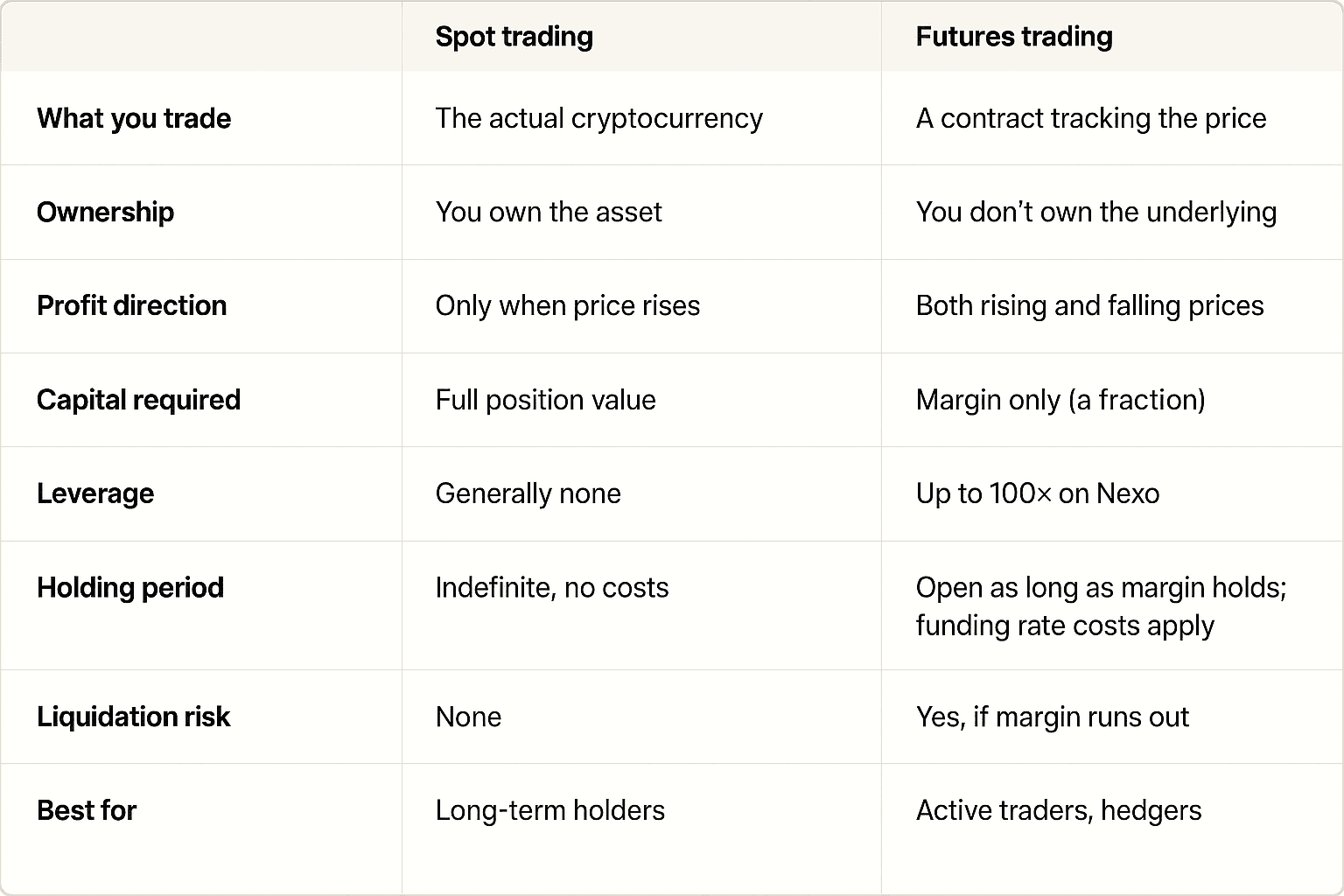
That difference matters. In spot, the usual path to profit is simple - buy lower and sell higher later. With perpetual futures, profit can come from a long in an uptrend or a short in a downtrend, and leverage makes a smaller market move matter more on your margin. The trade-off is that futures also add liquidation pressure and funding costs, while spot ties up more capital and leaves you waiting on price appreciation.
Why Trading Strategies Matter
Futures can generate opportunity in both directions, which is part of the appeal for day trading and active management. Still, a random entry with leverage is usually expensive. A strategy gives structure to the trade before money is at risk.
It sets your time horizon, defines where the entry should happen, and makes risk management less emotional. It also helps answer the practical question of how can I make money trading crypto futures. The short answer is through repeatable setups, measured position size, and disciplined exits.
Core Trading Strategies for Crypto Futures
There are several ways to approach a futures contract, but most active traders tend to cluster around a few methods that fit the pace of the crypto market.
Scalping Small Price Moves
Scalping is built around very short trades that target tiny market shifts. Positions may last seconds or a few minutes, and the goal is to repeat a simple setup many times.
Because perpetual futures trade continuously and usually have good liquidity in major pairs, scalpers can react quickly. Leverage makes a small move meaningful, though fees and funding can chip away at results if trade frequency gets excessive.
Example - if Bitcoin bounces between USD 99,800 and USD 100,000, a scalper may go long near the lower end and close near the upper end. That move is small on paper, but 10x leverage can turn roughly 0.2% into about 2% on margin before trading cost.
The method is math driven. It depends on repetition and control, not on guessing one huge breakout. The downside is obvious. One sloppy trade can wipe out a long stretch of small wins.
Swing Trading the Market Trend
Swing traders hold a futures trade longer, often for several days or a couple of weeks. The idea is to catch a broader market trend driven by momentum or a change in sentiment.
Futures work well here because perpetual contracts do not expire on a fixed date. A trader can stay long or short while using moderate leverage instead of forcing oversized exposure.
Example - ETH pushes through resistance near USD 3,000. A swing trader buys at USD 3,050, sets a stop near USD 2,950, and targets USD 3,350. If price reaches the target, the move is around 10%. At 3x leverage, the return on margin can be around 30% before fees and funding.
This style requires patience. You are trying to ride the main move rather than reacting to every intraday fluctuation. The main risk is holding through funding changes or a sharp overnight move.
Breakout Trading in Volatile Conditions
Breakout traders focus on moments where price escapes a tight range. That often happens near news events or after a long quiet stretch, when volatility suddenly returns.
Example - Bitcoin trades between USD 98,000 and USD 100,000. A trader sets one trigger above the range to catch an upside move and another below the range to catch a downside move. Once one side activates, the other order is canceled.
The edge here is preparation. You decide the plan before the market starts moving. The main danger is the false breakout, where price pushes through a level and then snaps back.
Many traders check volume or short-term volatility for confirmation. I like that approach because it filters out some weak moves without overcomplicating execution.
Hedging Existing Holdings
Hedging uses futures as protection rather than speculation. If you already hold a spot position, a short futures contract can offset part of the downside during a shaky period.
Example - you hold 1 BTC as part of a long-term investment or portfolio. If you expect short-term weakness, you can open a short BTC futures position of similar size. If Bitcoin drops 10%, the spot holding loses value, while the short contract can gain by roughly the same amount.
This approach lets an investor stay exposed to long-term upside without selling the underlying currency. The downside is simple. If price rises strongly, the hedge limits the benefit from that move.
Some traders also hedge by opening opposite futures positions to reduce active exposure for a while. It can work as a temporary pause button, though funding cost and execution still need attention.
Can You Make 100 or 500 a Day
Yes, it is possible to make USD 100 or even USD 500 a day trading crypto futures, but that outcome depends on account size, leverage, volatility, and trade quality. It is not a fixed daily income stream, and trying to force one usually leads to overtrading.
A small account chasing USD 500 a day often has to use aggressive leverage, which pushes liquidation risk much closer. A larger account can target the same dollar amount with less stress, though the market still has to offer a valid setup. The better question is whether your edge is consistent after fees, funding, and mistakes.
A rough math check keeps expectations grounded. With a USD 2,000 account, making USD 100 in a day means a 5% gain on total capital. If that trade uses 5x leverage, a 1% move in your favor on full exposure can get you there, but a 1% move against you can cut the account by about the same amount before fees. Reaching USD 500 on that same account means a 25% daily return, which usually pushes traders toward oversized risk.
With a USD 10,000 account, the picture changes. A USD 100 day is a 1% account gain, and a USD 500 day is 5%. Those numbers are still demanding, though they are more realistic if volatility is high and position size stays controlled. The catch is simple - losing days use the same math, and leverage speeds that up too.
Is Trading Crypto Futures Profitable
It can be profitable for a disciplined trader, especially in markets where price swings are large and liquidity is healthy. Futures give more ways to trade than spot because you can short weakness and use leverage to improve capital efficiency.
Still, profitability is fragile if risk management is weak. Losses from liquidation, funding payments, poor timing, or bad management can erase good trades quickly. A profitable approach usually looks boring from the outside. Entries are selective, size is controlled, and exits are planned before the order is sent.
Costs matter more than many traders expect. Fees on entry and exit reduce every result, funding rates can drain a position held too long, and slippage can make the actual fill worse than the planned one. The other side is psychological discipline. Revenge trading or moving a stop after entry can ruin a setup that looked fine on paper.
Using These Ideas on Nexo Futures
Once the mechanics make sense, execution is easier to evaluate. On Nexo Futures, traders can access more than 100 perpetual contracts and use collateral such as BTC, ETH, or stablecoins.
The platform also supports leverage up to 100x on eligible trades, with controls for stop loss and take profit. Those tools matter because they turn a trading strategy into an actual plan on screen. During testing, the ability to set exits while opening a position felt practical and quick, which is exactly what active traders need in a volatile market.
There is also Demo Trading, which is useful for checking how a futures trade behaves before real money is exposed. That matters more than it sounds, especially if you are still learning how margin reacts during fast price movement.
In a typical setup, the most you usually expect to lose is the margin posted to that trade because liquidation closes the position before losses keep expanding. Gains can be much larger in percentage terms if the market moves your way. Still, platform rules matter, so it is worth checking how the venue handles extreme volatility and any edge case where losses move beyond posted collateral.
Risks and Better Habits
The biggest obstacles are usually easy to name and hard to control. Fast volatility can move a contract against you before there is time to react. High leverage brings liquidation much closer, while funding costs and slippage quietly eat into returns. There is also platform risk during heavy market stress, and emotional trading can wreck risk management even when the original setup was sound.
- Use lower leverage to keep more room before liquidation
- Watch volatility so margin pressure does not catch you off guard
Trade frequency deserves attention too. More activity does not always mean more profit. In many cases, a small number of planned trades is easier to manage than constant clicking.
- Use a stop loss if the setup calls for one
- Review closed trades to see if the strategy still works after cost and slippage
Is Crypto Futures Trading Right for You
For beginners, futures often make more sense as a learning tool than as a main investment approach. The product is powerful, but it expects you to understand leverage, margin, and liquidation before you size up.
It may fit if you can monitor positions actively and accept the possibility of losing the posted margin. It may fit less well if you are still getting comfortable with basic cryptocurrency mechanics or if you prefer slower stock-style investing.
There is no universal answer here. The right fit depends on your tolerance for risk and how much time you can give to active trade management.
Frequently Asked Questions
Do you own crypto when trading futures
No. You trade a contract linked to the price of the asset rather than holding the asset itself.
Can beginners trade crypto futures
Yes, most platforms allow access, but the learning curve is steeper than in spot. A beginner should understand leverage, margin, and liquidation before risking capital.
Are crypto futures only for advanced traders
No. Everyday users can trade them, though starting small and focusing on risk management is the safer path.
Is futures trading the same as margin trading
No. They are related, but they work differently. Futures use a derivative contract with built-in leverage, while margin trading often involves borrowed funds to trade a spot asset.
Can you lose more than you invest
That depends on platform rules and protections. On many venues, losses are generally limited to posted margin, but they can happen very quickly.
Can I lose my entire margin
Yes. If the market moves far enough against the position, liquidation can consume all posted collateral.
What does perpetual mean in crypto futures
Perpetual futures have no expiry date. The position can stay open as long as margin remains sufficient and funding payments are covered. Funding acts like a balancing mechanism, shifting interest between longs and shorts so the contract price stays close to the spot market.
Do I need leverage to trade crypto futures
Futures are built around leverage, even at low settings such as 2x. You can choose a conservative level, and that is usually more sensible for a new trader.
Can I hold a futures position for the long term
Technically yes, especially with perpetual contracts. In practice, it is risky because volatility, funding cost, and liquidation pressure build over time.
Which strategies are common in futures trading
Common approaches include scalping for short moves and swing trading for broader trends. Breakout setups and hedge positions are also widely used depending on the trader’s goal.