

Pipcy Prop Trading Firm Review
Pipcy enters the market with a familiar prop model and a few sharper twists, so a proper Pipcy prop trading firm review needs to separate headline claims from the actual setup. Based on the published launch details, the firm plans to go live in May 2026 with low entry pricing from $18, a stated payout window of 48 hours, up to 95% performance split, and two evaluation paths including a PIP-based format that shifts the focus away from raw account balance swings.
The core structure follows standard proprietary trading logic. A trader pays for an evaluation, works through the challenge rules, and if the target is met within the limits, the account can move into the funded stage with a share of simulated performance. The interesting part here is the way Pipcy frames measurement, platform access, and education inside the same product flow.
Pipcy says the launch will include two challenge models and a 50% welcome discount on the Classic Challenge for new users. Full specs are scheduled to appear on the company site on launch day, so some important details still need live verification. At this stage, parts of the offer still rely on pre-launch claims and may change once Pipcy goes live. Challenge rules, pricing, and payout terms should be checked again on the official Pipcy website at launch.
Our editorial team found no disclosed sponsorship, affiliate compensation, or paid placement from Pipcy in the material used for this page. The assessment is independent and based on published launch details, background checks on the team, and a review of the rule claims that were available before launch.
How Pipcy Frames Its Funded Trading Model
Pipcy positions itself as a proprietary trading firm that backs users after they pass an evaluation. The basic path is simple - pay the fee, complete the challenge, then move to a funded account with a profit split. On paper that is standard for the sector, though Pipcy tries to stand apart through performance measurement, platform infrastructure, and built-in training.
One point worth stating clearly in any legitimacy check is how the model should be understood. The available pre-launch material presents the service as simulated trading rather than direct brokerage access to live financial instruments. I did not see a published legal page in the reviewed material that confirmed the legal entity name, jurisdiction, or regulatory status, so those points still need to be checked on the official site at launch. That distinction matters for any trader in the foreign exchange market because it changes how money, execution, and reward mechanics should be assessed. A firm can still be legitimate in this format, but users should read the legal disclosures carefully and confirm who provides the service and whether any broker relationship exists at all.
- Two challenge tracks - Pipcy Classic and Pips Mastery
- Entry cost from $18, with a launch discount on the Classic option
- Up to 95% performance split for funded users
- Payout handling within 48 hours, stated as a policy
- Classic rules built around 12% absolute max loss and no daily drawdown cap
- Access through MetaTrader 5 and a proprietary Pipcy platform
- Pipcy Academy included without a separate fee
Two Evaluation Paths for Different Trader Profiles
Rather than pushing one flagship challenge, Pipcy launches with two routes. That matters because the two paths test skill in different ways, and the choice can change how a trader approaches risk management.
The Pipcy Classic Challenge
The Classic Challenge is the more familiar route. It tracks progress in dollar terms and is aimed at people who already know how prop evaluations usually work. Account growth is measured by balance performance, and the structure is meant to support scaling into larger funded allocations over time. During launch, this is the program receiving the 50% welcome offer.
Additional rule data tied to Pipcy comparisons suggests two Classic versions may be available, including a 1-Step and a 2-Step model. The 1-Step version is described with a 12% max loss and an 18% target. The 2-Step version keeps the same max loss but splits the target into two phases. In both cases, no daily drawdown is listed and the minimum trading period is said to be 3 days.
The Pips Mastery Challenge
Pips Mastery is the more unusual part of the offer. Instead of grading performance by changes in dollar balance, the system tracks captured PIPs. That changes the feel of the evaluation because it leans more toward execution quality and less toward aggressive leverage. From a review angle, this is the clearest attempt by Pipcy to put distance between itself and the usual prop template.
Based on the supporting analysis, Pips Mastery may launch with versions tied to 500 PIPs and 750 PIPs as target levels, with max loss set at 250 PIPs and no daily drawdown. News trading is also said to be allowed. I would still treat those figures as prelaunch claims until the live rules page confirms them.
Pricing, Rules, and the 48-Hour Payout Claim
Pipcy states that challenge pricing begins at $18, which puts it below many better-known firms at the entry tier. Published pre-launch comparisons point to Pips Mastery as the cheapest entry and Classic as slightly higher, but the reviewed material did not show a full fee table by account size. I also did not find a confirmed statement on whether challenge fees are refundable or non-refundable, so that should be verified on the official Pipcy pricing page at launch.
| Challenge Type | Account Size | Entry Fee | Profit Split | Max Loss | Target | Payout Speed |
|---|---|---|---|---|---|---|
| Pips Mastery | Not fully published pre-launch | From $18 | Up to 95% | 250 PIPs claimed | 500 PIPs or 750 PIPs claimed | 48 hours stated |
| Pipcy Classic | Not fully published pre-launch | Higher than Pips Mastery in reviewed comparisons | Up to 95% | 12% max loss claimed | 18% on 1-Step claimed | 48 hours stated |
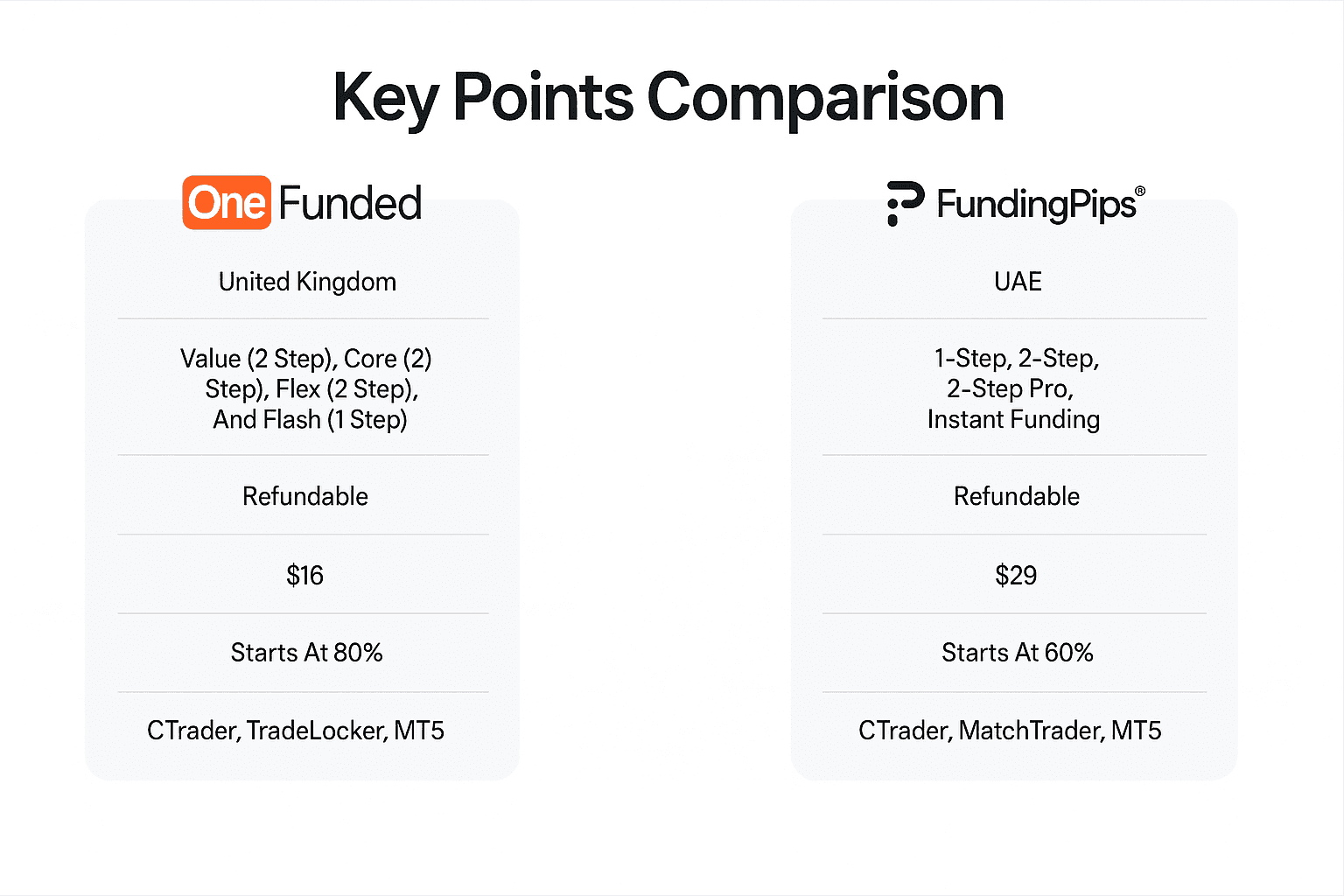
The payout term is one of the claims most people will focus on. Pipcy says withdrawals are processed within 48 hours. That directly answers the common question about how long Pipcy or Funding Pips take to process payouts, at least from the company side. Pipcy publishes 48 hours as its stated standard. Funding Pips can differ by case and queue load, so the safer way to compare them is to check current user reports and the exact payout policy page before paying for any evaluation.
A fast payout promise is easy to write into marketing copy. The real test starts after the first wave of funded accounts reaches withdrawal stage. If I were checking this in practice, I would watch public payout proofs and support response quality as volume picks up.
Platforms and Trading Infrastructure
At launch, users are expected to get two platform choices - MetaTrader 5 or Pipcy’s in-house system. That split is practical. MetaTrader 5 gives familiar charting and workflow, while the proprietary stack gives Pipcy tighter control over its own infrastructure, user dashboard, and internal data handling.
That setup may also matter for execution consistency and account monitoring. A firm that owns more of the backend usually has more room to tune the user experience, though it also takes on more technical responsibility. In prop environments built around simulation, platform stability, dashboard accuracy, and rule tracking are often more important than flashy UI. I tend to look at latency on challenge dashboards and the clarity of breach reporting first, because that is where weak systems usually show themselves.
The Team Behind Pipcy
Pipcy says the company was built by a team with long market experience and direct exposure to the prop sector. The firm ties much of its structure to that background, especially on platform design and evaluation logic.
Omer Ben Matityahu, the CEO and founder, comes from fintech entrepreneurship with a focus on trading infrastructure. That lines up with the decision to run a proprietary platform alongside MetaTrader 5, as well as an internal CRM and dashboard.
Snir Ahiel leads risk management and consulting. He brings more than 15 years across forex, stocks, and options, and he is identified as a co-founder of The5ers. Pipcy connects its challenge rules to that background, particularly the choice to allow broader room on total loss while removing the usual daily drawdown restriction. The idea seems to be testing discipline without forcing a trader out on routine market liquidity swings.
Vladimir Rybakov heads Pipcy Academy. He is presented as a CFTe-certified market technician with 19 years of experience, starting on the brokerage side before moving deeper into analysis and education. His focus areas include price action and market structure, which fits the educational layer Pipcy is putting next to the evaluation itself.
Pipcy Academy Inside the Product
Many firms bolt education onto the sales page and leave it there. Pipcy describes its Academy as part of the core service instead. The stated goal is to help users improve decision quality during evaluation, with emphasis on risk, execution discipline, and management under pressure.
The material is taught through Vladimir Rybakov’s market approach and supported by Snir Ahiel’s risk management perspective. Pipcy also says the Academy has no upsells and no paid certification ladder. That may sound like a small point, but it does affect trust. If the education exists to improve account survival rather than upsell courses, the incentive structure is cleaner.
How to Judge Legitimacy and Trust
A lot of people ask which is the most trusted prop firm. There is no single universal answer, because trust is earned through payout history, rule consistency, and how disputes are handled. Firms such as FTMO and The5ers are usually discussed first because they have a longer operating record and a larger body of user feedback. Pipcy is newer, so it has less historical proof at launch.
| Firm | Entry Fee Lowest | Profit Split Max | Payout Speed | Rule Strictness | Transparency | Years in Operation |
|---|---|---|---|---|---|---|
| Pipcy | From $18 claimed | Up to 95% claimed | 48 hours stated | Appears less strict on daily drawdown in reviewed material | Limited pre-launch proof | Launching in 2026 |
| FTMO | Higher than Pipcy entry level | Lower than Pipcy headline maximum in typical public offers | Check current policy | Well-defined and established | High | Longer track record |
| The5ers | Higher than Pipcy entry level in most comparisons | Check current policy | Check current policy | Established | High | Longer track record |
| Funding Pips | Check current pricing | Check current policy | Queue dependent by case | Check current rules | More established than Pipcy at launch | Longer track record than Pipcy |
If you want to check whether a prop firm like Pipcy is legitimate and safe, use a simple checklist.
- Check the company registration and legal disclosures.
- Confirm whether the evaluation uses simulated trading.
- See which company serves your jurisdiction.
- Look for payout proofs and independent user feedback.
- Test support with a basic rules question.
- Read the breach rules closely.
- Check whether the firm claims to be a broker or holds client funds.
Before trusting a new prop firm, verify the legal disclosures and look for real payout proofs.
In the material surrounding Pipcy, the service is described as simulated evaluation rather than a traditional broker setup. That distinction matters for risk. In a proprietary trading challenge, the main exposure is usually the fee paid for access and the fairness of the evaluation environment. It is less about direct commodity or FX custody, and more about whether the rule engine, market data, and account management system behave the way the firm says they do.
What the May 2026 Launch Suggests
The broader prop space has been under more scrutiny, with users paying closer attention to rule design and payout behavior. Against that backdrop, Pipcy is trying to compete on trader economics. The lower starting fee, the 95% split ceiling, and the stated 48-hour payout window all point that way.
The same applies to the no-daily-drawdown approach on Classic and the PIP-based evaluation on Pips Mastery. Both are framed as attempts to test trading skill in a way that reflects actual performance rather than forcing mechanical failures. Whether that works in live usage will depend on how fair the evaluation engine feels once people start to trade it at scale.
About Pipcy
Pipcy is a proprietary trading firm scheduled to launch in May 2026. The company offers funded-account access through two evaluations, including the Pipcy Classic route and the Pips Mastery route. Published launch material highlights pricing from $18, a profit split of up to 95%, payout processing within 48 hours, access through MetaTrader 5 and a proprietary platform, plus a free education layer through Pipcy Academy. The business is led by Omer Ben Matityahu, with Snir Ahiel overseeing risk management and Vladimir Rybakov leading the Academy.